APEX survey of interstellar HCl: ³⁵Cl/³⁷Cl isotopic ratios in dense cores and outflows
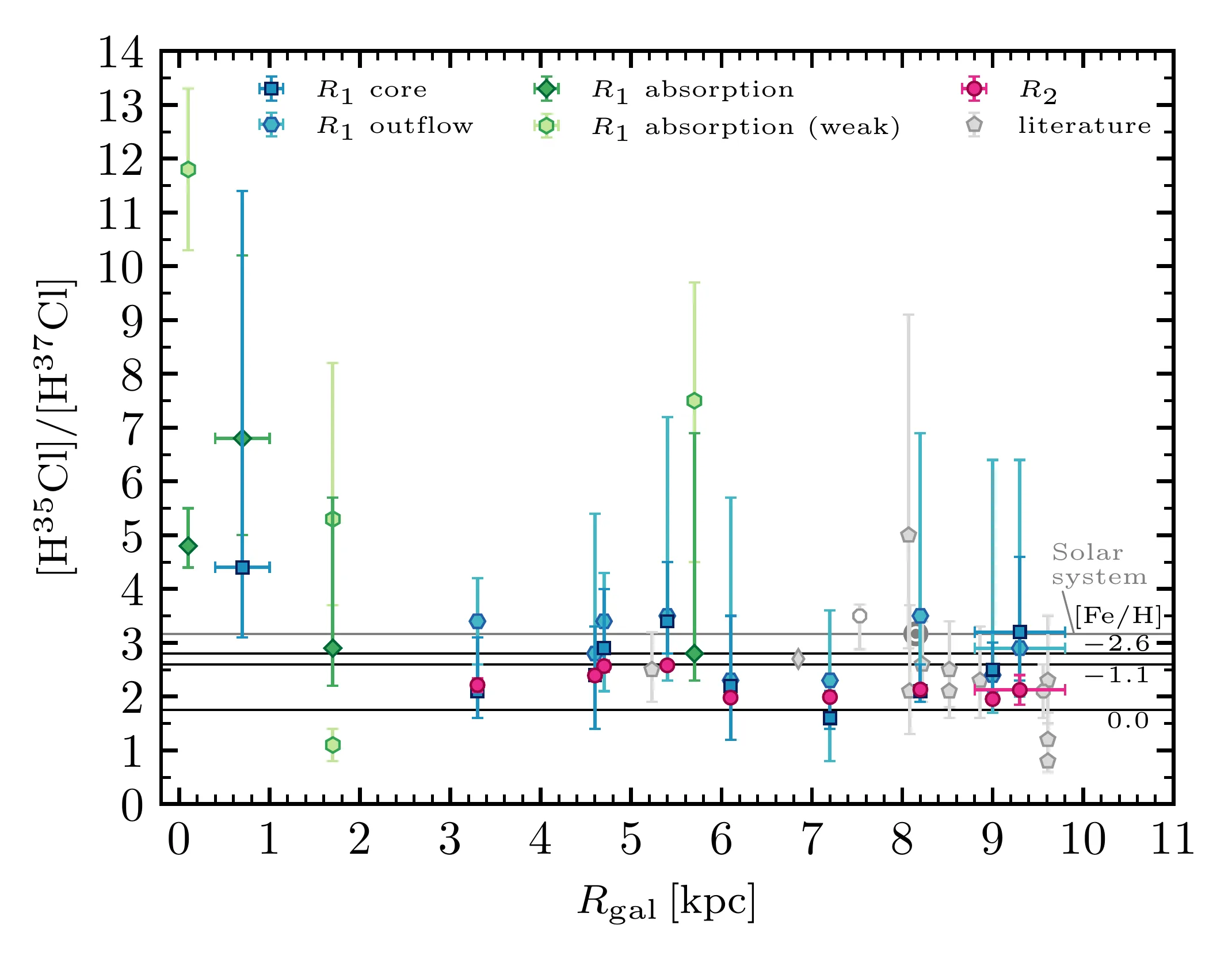
A systematic survey of hydrogen chloride (HCl) toward 28 high-mass star-forming regions, observed with the SEPIA660 receiver on the APEX 12 m telescope. H³⁵Cl is detected in every source, and the ³⁵Cl/³⁷Cl isotopic ratio is measured across a wide range of Galactocentric radii.
The ratios trace a gradient consistent with Galactic chemical-evolution models, in which the two chlorine isotopes are built up at different rates as the Galaxy ages and enriches. Several sources with strong molecular outflows show ratios that diverge from this trend, pointing to local chemical or excitation effects distinct from the Galactic-scale pattern – the starting point for the explosive-outflow follow-up described on the Research page.
I surveyed 28 massive star-forming regions for a molecule called hydrogen chloride, using a radio telescope in Chile, and found it in every single one. Comparing two slightly different versions of chlorine in each source traced a pattern that matches how the Galaxy's chemistry has built up over billions of years. A handful of sources broke that pattern – the first clue leading to the explosive-outflow story described on the Research page.
I looked for a certain kind of gas in 28 different star-forming clouds, and found it in every one. By comparing two slightly different versions of one of its atoms, I could tell how the Galaxy's chemistry has changed over a very, very long time. A few clouds looked strange – and that turned out to be a clue about stellar explosions, which you can read about on the Research page.