Research
My work asks how massive stars and the clusters around them keep assembling mass once stellar feedback is already underway – tracing gas from parsec-scale filaments down into individual cores, and using chlorine chemistry as an independent probe of the physical conditions along the way.
I study how the most massive stars and the clusters around them keep growing, even after those stars start pushing back against the very gas they're made from. I trace how gas moves in from far outside a cluster all the way down to individual forming stars, and I also use a particular molecule, hydrogen chloride, as a chemical fingerprint to learn about conditions inside these clouds.
I study the biggest stars and how they grow, even after they start pushing back against their own food (the gas around them). I watch gas falling in from far away all the way down onto the stars, and I use a molecule called hydrogen chloride like a detective's clue to learn about the clouds they're born in.
MACNIFY I: Filamentary hub-accretion
Multi-scale ACcretion aNd Ionising Feedback in a Young cluster
VLA · GBT · hub-filament systems
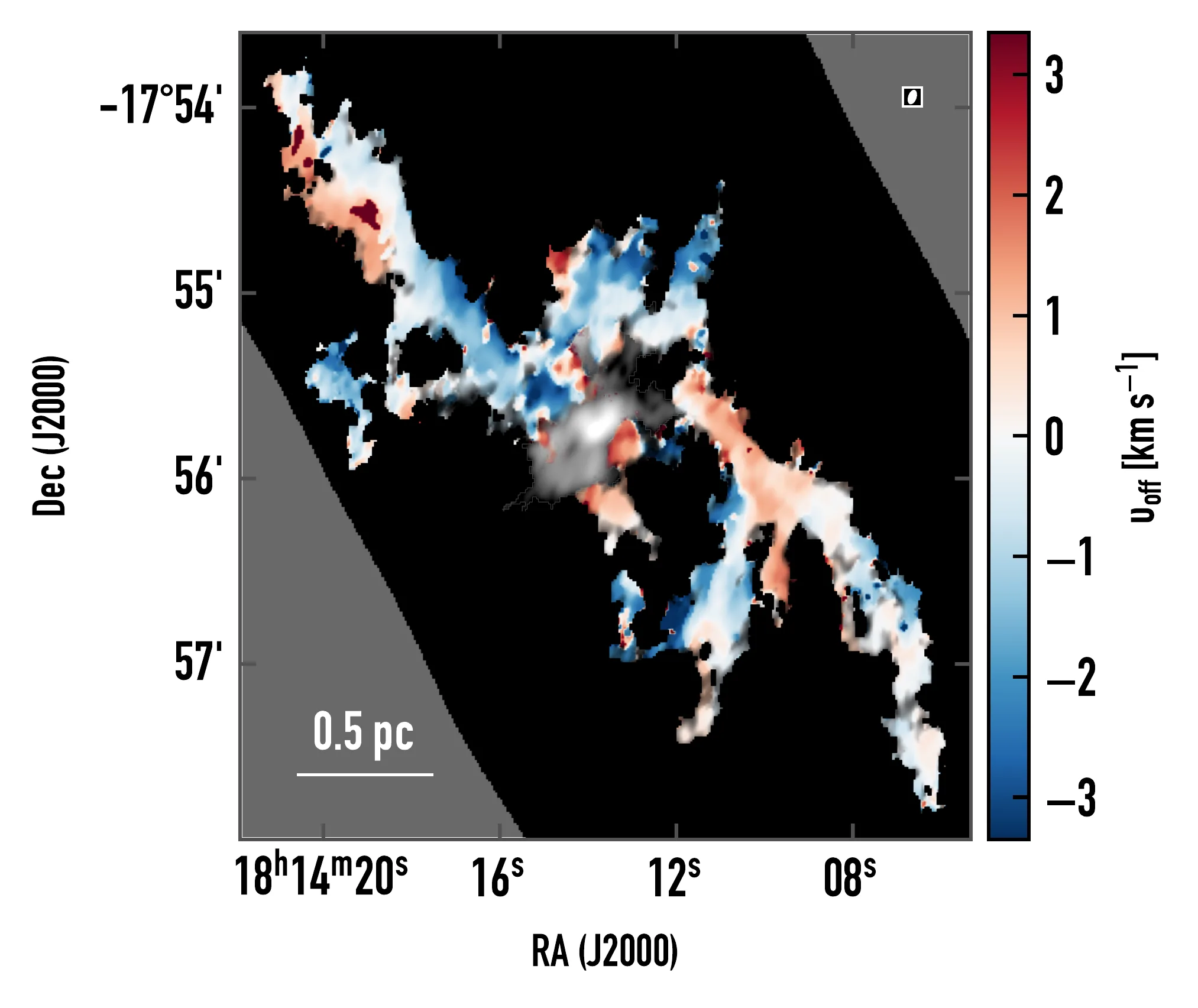
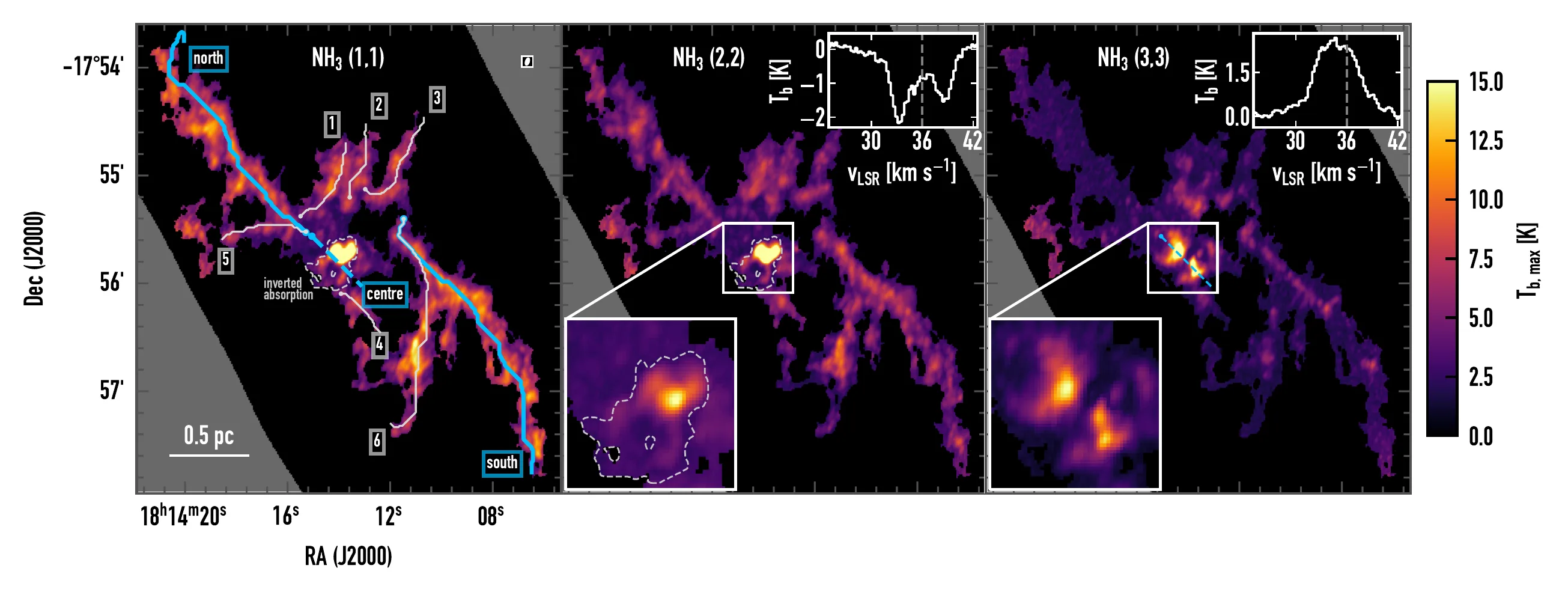
MACNIFY is a project tracing how gas assembles mass in W33 Main, a hub-filament system where massive-star feedback is already active. The first paper in the series (MACNIFY I) asks whether the two dominant parsec-scale filaments feeding the hub remain kinematically connected into the feedback-affected centre, using Very Large Array ammonia (NH₃) observations complemented by Green Bank Telescope short-spacing data.
A separate, PI-led ALMA project extends this to much smaller scales (~200 au): “From filaments to cores: tracing multi-scale accretion in W33 Main” follows the same gas flow down into individual protostellar cores, and a PI-led SMA project probes whether magnetic fields help drive – or resist – cluster formation in the same system.
MACNIFY is a project that follows gas as it falls into a young, massive star-forming region called W33 Main, where the biggest stars have already switched on. The first study in the series checks whether two long streams of gas, each several light-years long, are still smoothly connected all the way into the crowded centre, using a radio telescope that can see the glow of ammonia gas.
A related project zooms in much further, down to a few hundred times the distance between the Earth and the Sun, to watch that same gas flow onto individual forming stars, while a third project checks whether magnetic fields are helping or hindering the cluster's growth.
MACNIFY watches gas pour into a busy star nursery called W33 Main, where some stars are already big and bright. The first study checks whether two long rivers of gas, stretching for trillions of kilometres, are still connected all the way down to the crowded middle, or whether they break apart on the way.
A second project zooms in much, much closer, to watch the gas land right on baby stars, and a third checks whether invisible magnetic fields are helping or getting in the way.
MACNIFY II: Stellar feedback
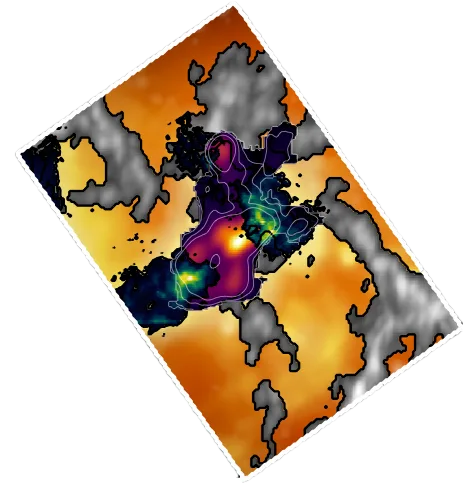
Once the most massive stars in a forming cluster switch on, their ionising radiation carves out H II regions and drives winds that begin to disperse the gas around them. W33 Main's central hub already shows this directly: VLA K-band radio recombination lines trace the ionised gas in the same observations used to map the dense NH₃ filaments, and I complement this with near-infrared integral-field spectroscopy from VLT/KMOS, tracing the ionised gas through Brackett-γ emission – together making the hub a natural laboratory for studying how accretion and feedback coexist in the same region, rather than treating them as separate phases of cluster formation.
Once the heaviest stars in a young cluster switch on, they flood the surrounding gas with ultraviolet light, carving out bubbles of hot gas and driving outflowing winds. I can see this hot, glowing gas directly, using the same radio observations that map the dense gas, together with a second set of observations in infrared light. Studying both at once lets me watch gas still falling in and gas being blown away happening in the very same place, rather than assuming a cluster simply switches from "growing" to "done growing."
Once the biggest stars switch on, they glow fiercely and blow out wind, like a flashlight and a fan turned on at the same time. That heats up and pushes away the gas nearby. I use radio dishes to see that glowing gas, at the very same time and place as the gas still trying to fall in, so I can watch both happening together instead of one after the other.
Astrochemistry of hydrogen chloride
APEX · SEPIA660 · CHLORINE CHEMISTRY
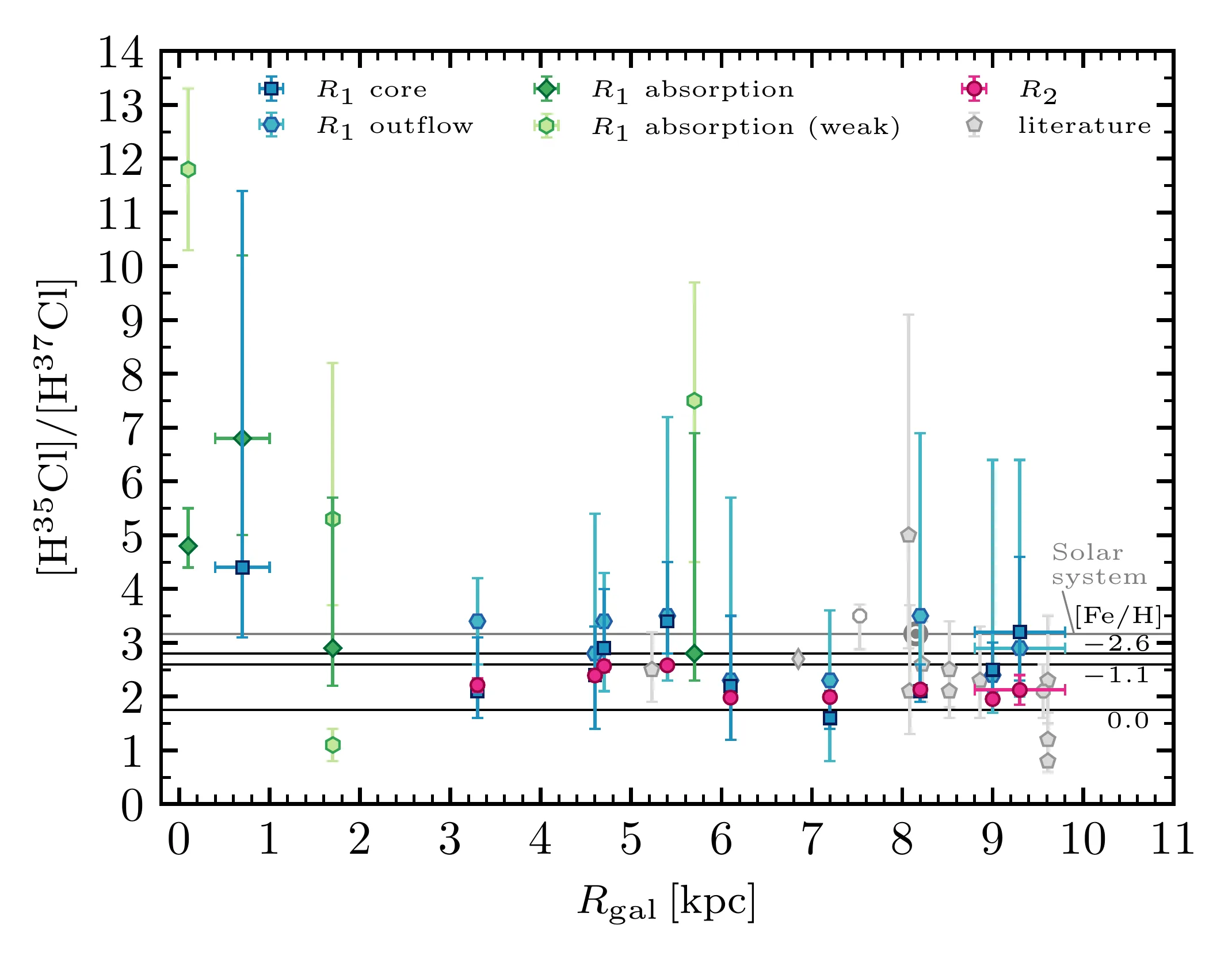
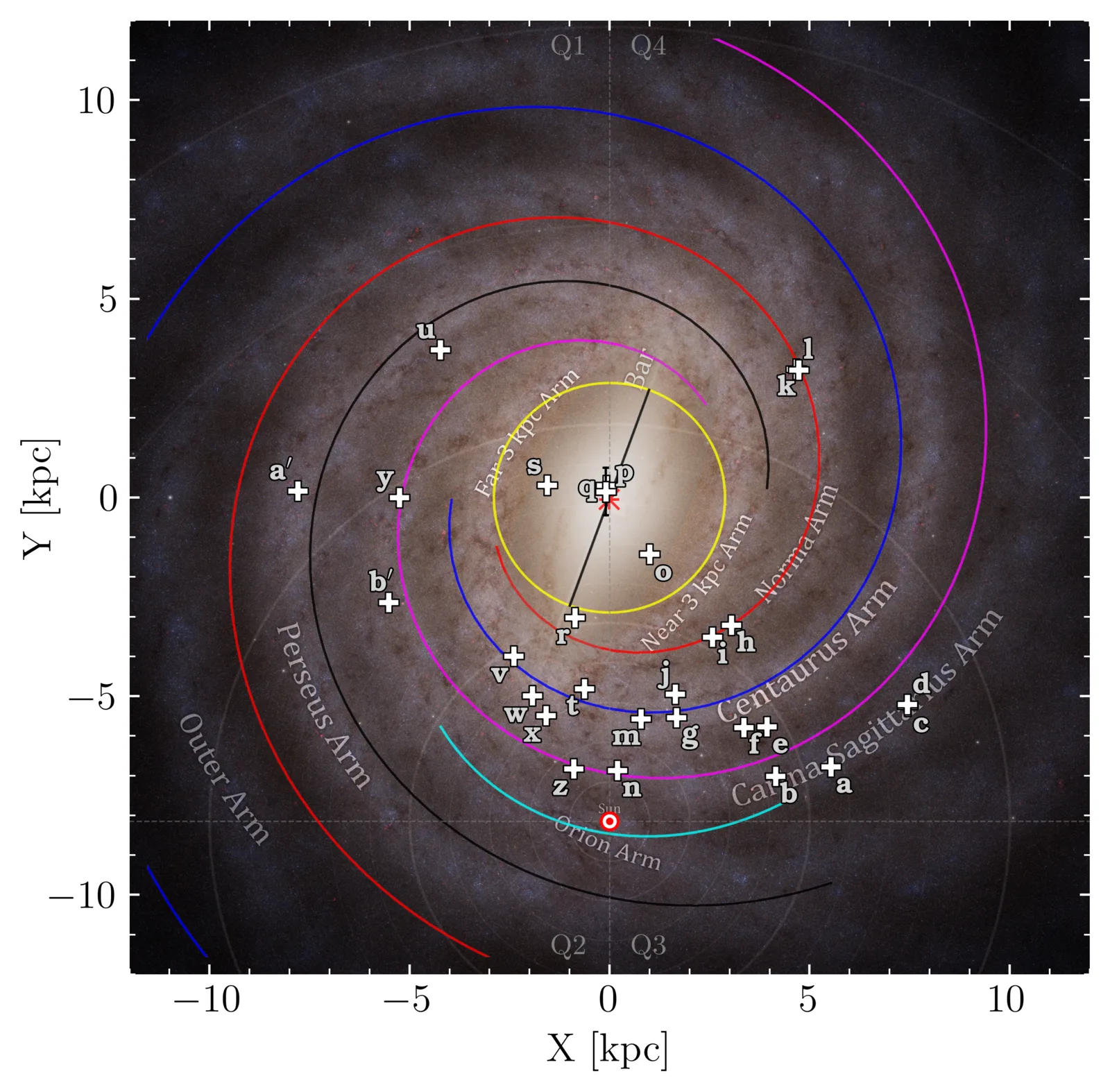
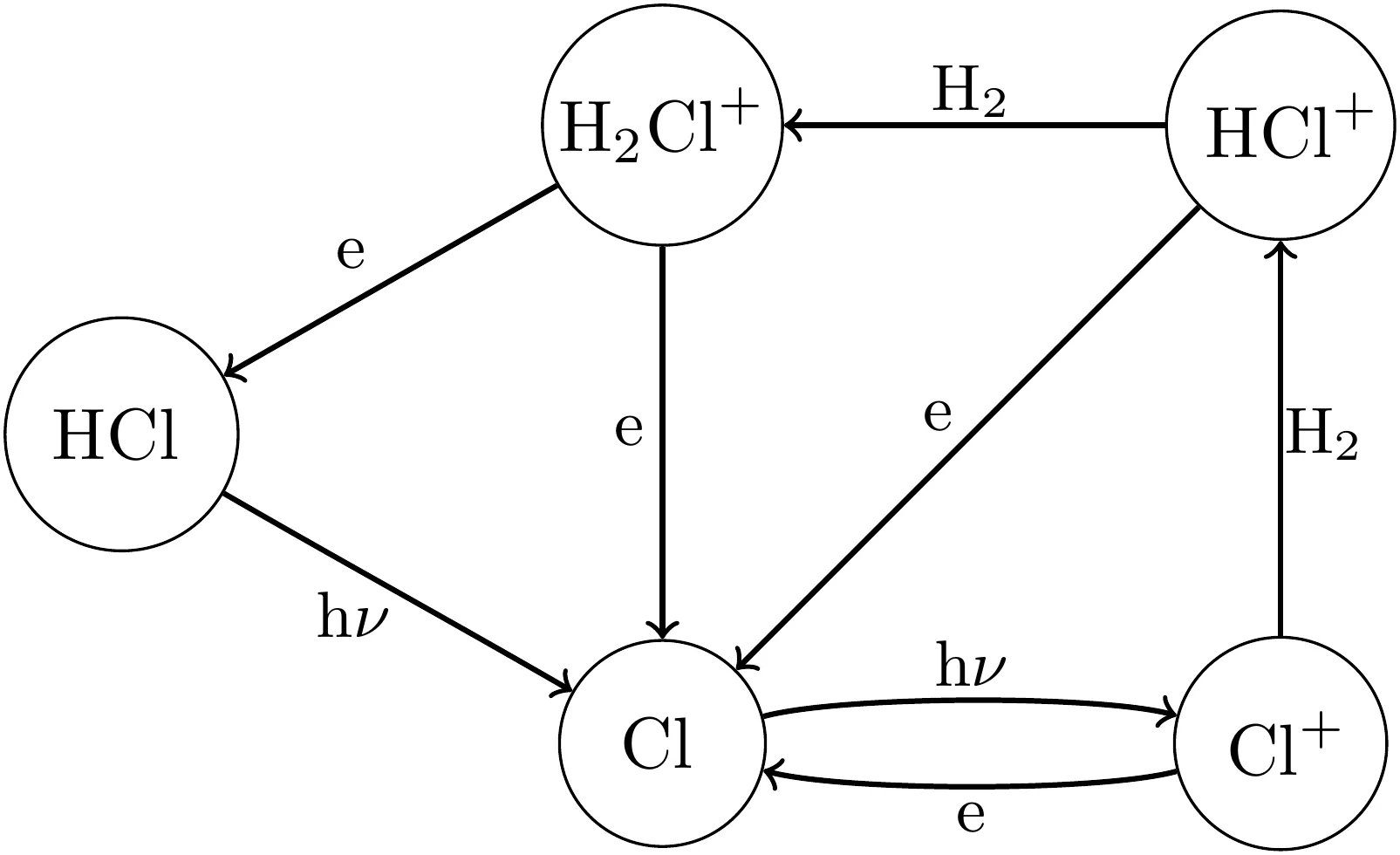
Chlorine has an unusually simple interstellar chemistry, dominated by just a handful of species whose balance shifts sharply with UV shielding and density. Hydrogen chloride (HCl) is the main gas-phase reservoir of chlorine in dense, well-shielded gas, which makes it a sensitive probe of both galactic chemical evolution and the local physical conditions in star-forming regions.
Chlorine is one of the simplest elements to track in interstellar clouds: in most conditions it exists as just one of a handful of molecules, and which one depends mainly on how much starlight can get in and how dense the gas is. The molecule hydrogen chloride holds most of the chlorine in the thickest, most shielded gas, which makes it useful both for tracing how the Galaxy's chemistry has changed over time, and for probing conditions inside individual star-forming clouds today.
Chlorine is a simple element to follow in space clouds: almost all of it hides in just a few different molecules, and which one depends on how much starlight and squeezing the gas gets. One of those molecules, hydrogen chloride, is like a tag I can track to learn how the Galaxy's chemistry has changed over billions of years, and what's going on inside a cloud today.
An unexpected signpost: HCl in explosive outflows
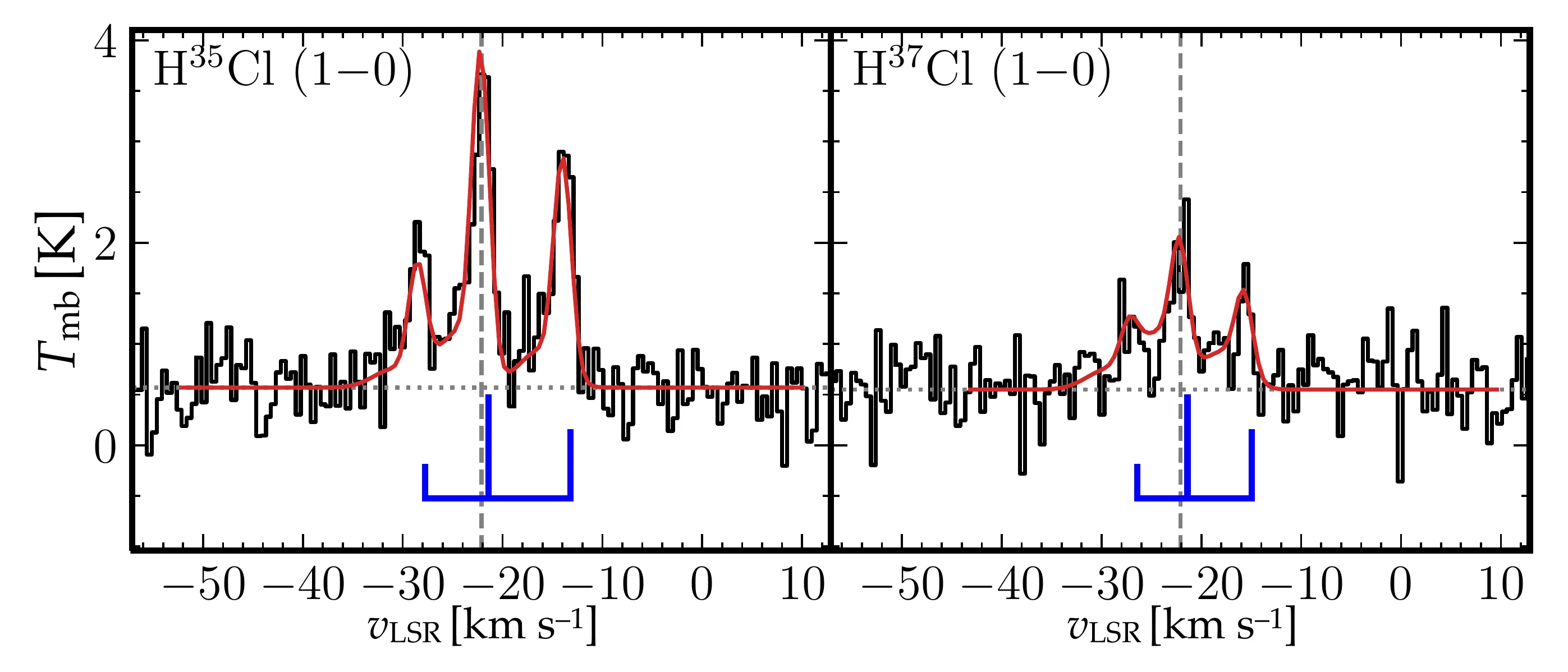
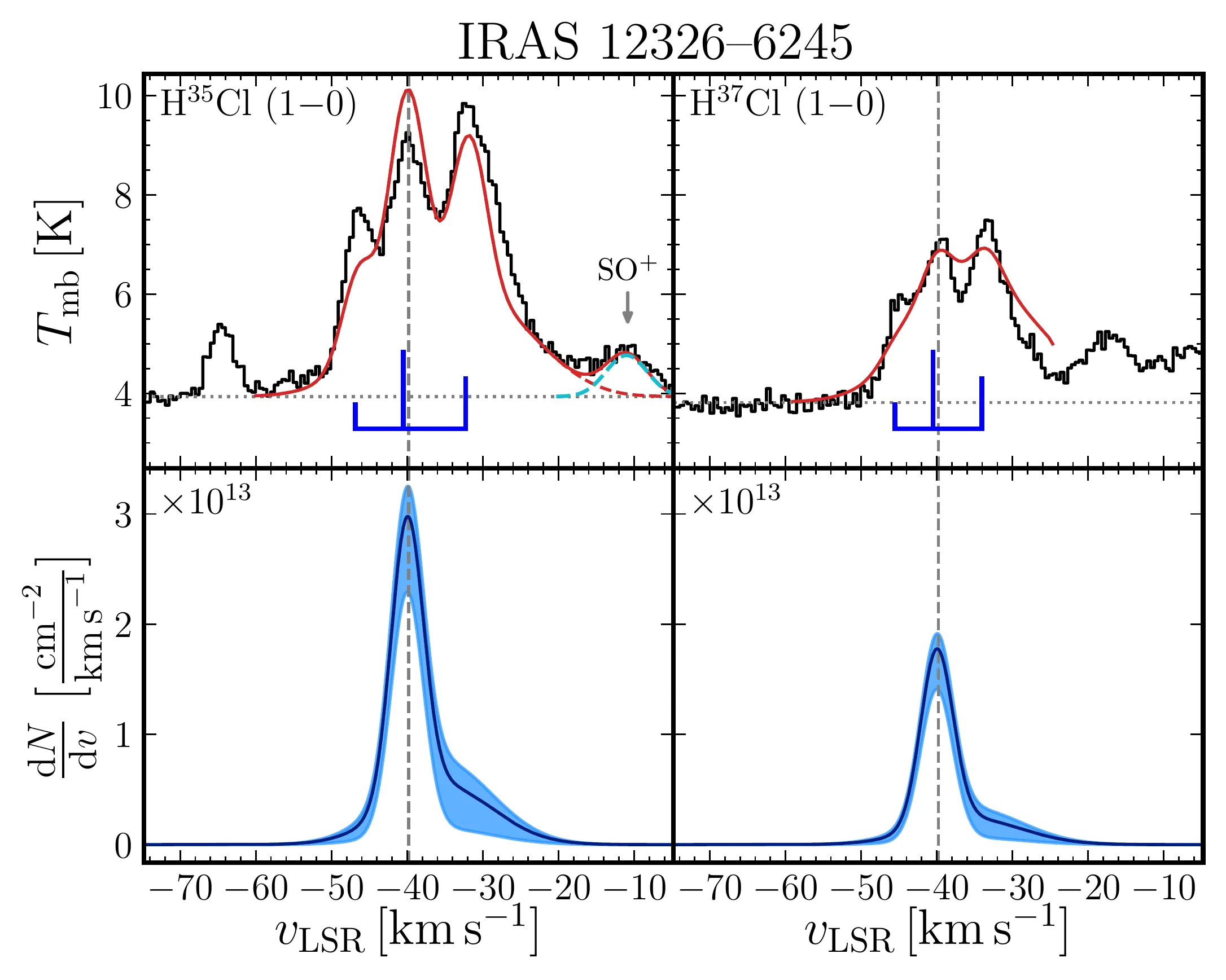
Reproducing the HCl line profiles in the APEX survey required an extra, broad, kinematically-offset component in several sources – on top of the narrow component tracing quiescent dense gas. This broad component turned out to be strongest toward sources known to host explosive outflows: rare, short-lived events where a protostellar merger or disruption launches high-velocity streamers of gas, identified by their characteristic radial CO streamers. HCl has now been detected in four of the small number of confirmed explosive outflows in the Milky Way, with IRAS 12326−6245 showing the most prominent example.
Whether this reflects a genuine chemical link between HCl and the explosive-outflow mechanism – for instance, shocks releasing chlorine that is otherwise frozen onto dust grains – or simply an observational bias toward the brightest sources can't be resolved with single-dish data alone. A Cycle 13 ALMA Band 9 proposal to map this emission at high resolution toward IRAS 12326−6245, led by Lennart Böhm, was highly ranked in review; it would provide the first interferometric test of whether the HCl emission traces the streamer bodies, the bow shocks at their tips, or the central protostellar source.
While analysing the chlorine survey, I found that a few sources needed an extra, broader signal on top of the usual narrow one, as if some of the gas were moving much faster than the rest. Those sources turned out to overlap with a rare, dramatic kind of event: anexplosive outflow, where two young stars collide or a forming star is violently disrupted, flinging gas outward at high speed. Hydrogen chloride has now been seen in four of the small number of known explosive outflows, most clearly in one calledIRAS 12326−6245.
It's still unclear whether this is a real chemical link – for example, the explosion knocking chlorine off dust grains and back into the gas – or whether it's simply that these are the brightest, easiest sources to detect in the first place. A newly approved observing proposal will use a much sharper radio telescope array to pin down exactly where the signal comes from in one of these explosions.
While looking at the chlorine survey, I noticed a few clouds had a strange, extra wobbly signal mixed in with the normal one, as if some of the gas were flying around much faster than usual. It turns out those same clouds had recently had a dramatic crash: two baby stars colliding or getting torn apart, flinging gas out at high speed. I've now spotted hydrogen chloride in four of these rare crashes, most clearly in one called IRAS 12326−6245.
I don't yet know if the crash actually makes more chlorine gas appear, or if I'm just noticing it because these crashes happen to be easier to spot. A newly approved observation with a much sharper telescope array should help answer that.
Detected explosive outflows in the Milky Way, and HCl's record toward them
Not an exhaustive list – explosive outflows are a very recently recognised class of event, and new candidates continue to be reported in the literature.
| Source | Explosive outflow | HCl observation |
|---|---|---|
| G005.89−0.39 | Zapata et al. (2019); Zapata et al. (2020) | Peng et al. (2010) |
| IRAS 12326−6245 | Zapata et al. (2023) | Böhm et al. (2026) |
| Orion BN/KL | Zapata et al. (2009); Bally et al. (2011, 2017) | Schilke et al. (2001) |
| G34.26+0.15 | Isaac & Lu et al. (2025) | Böhm et al. (2026) – absorption, weak in a single pointing |
| DR21 | Guzmán Ccolque et al. (2024) | not yet observed |
| IRAS 16076−5134 | Guzmán Ccolque et al. (2022) | not yet observed |
| Sh2-106 | Bally et al. (2022) | not yet observed |
Explosive outflows are themselves rare: Zapata et al. (2023) estimate one occurs roughly every 90 years in the Milky Way.